Once Upon a Molecule: How Storytelling Rewires Your Brain to Actually Understand Science
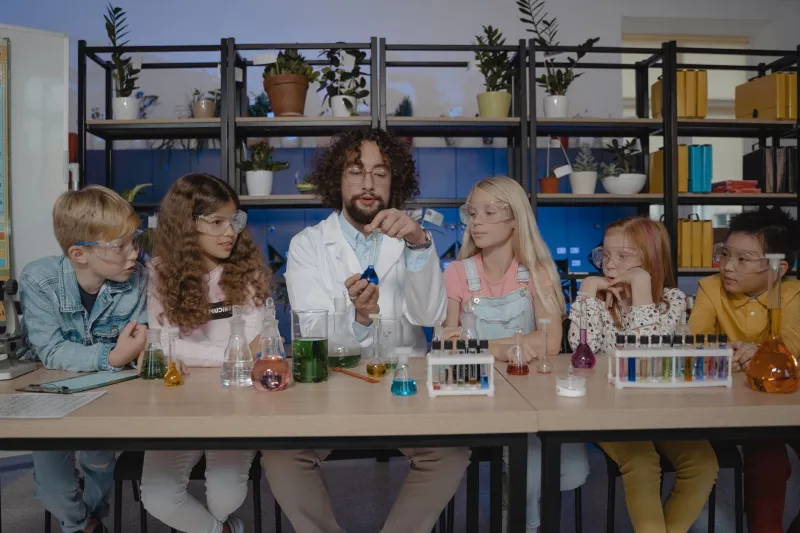
Picture this: You're sitting in a high school chemistry class, and your teacher is writing the steps of covalent bonding on the whiteboard in near-silence. You copy it down dutifully. Two weeks later, it's gone — vanished from memory like it was never there.
Now imagine your teacher instead opens with this: "Two atoms are so desperate to become stable that they literally share their most precious electrons — like two broke roommates splitting the WiFi bill."
Something clicks. You laugh. And weirdly, you never forget it.
That's not just a good teaching trick. That's your brain doing exactly what it was built to do. And the neuroscience behind it is genuinely fascinating.
Your Brain Is a Story Machine, Not a Filing Cabinet
For decades, traditional science education has leaned heavily on what researchers call declarative learning — facts, definitions, equations, and diagrams presented in isolation. The assumption was that if you exposed students to accurate information clearly enough, the learning would follow.
But modern neuroscience tells a very different story.
When you read a bullet-pointed list of science facts, functional MRI studies show that only two regions of the brain light up: Wernicke's area (language comprehension) and Broca's area (language processing). Useful, sure — but limited.
Now swap that list for a narrative — even a simple one — and the brain response is completely different. Suddenly you're activating the motor cortex, sensory regions, the limbic system (your emotional center), and areas tied to spatial reasoning and social cognition. Essentially, your brain responds to a story the same way it would respond to actually living through the experience.
This phenomenon, studied extensively by cognitive neuroscientist Uri Hasson at Princeton, is sometimes called neural coupling. When someone tells a compelling story, the listener's brain activity begins to mirror the storyteller's — a kind of mental synchrony that simply doesn't happen with dry, fact-based delivery. The more vivid and emotionally resonant the narrative, the tighter that coupling becomes.
The 'Narrative Transport' Effect: Getting Lost in Order to Learn
You've probably experienced it while reading a great novel or watching an engrossing documentary — that feeling of being completely pulled into another world. Researchers Melanie Green and Timothy Brock coined a term for it back in 2000: narrative transportation.
The idea is that when we get absorbed in a story, our critical resistance drops and our minds become far more receptive to new information. For science learners, this is a huge deal. One of the biggest barriers to understanding complex STEM topics isn't intelligence — it's the anxiety and mental resistance that kicks in the moment something feels abstract or intimidating.
Narrative transport essentially lowers that barrier. When you're following a character — even a metaphorical one — through a scientific concept, your brain is too busy being engaged to be scared.
Studies from Stanford's Graduate School of Education have backed this up in classroom settings, showing that students who received science instruction through story-based framing retained information significantly better than those taught through traditional lecture formats. More importantly, they were more likely to describe the subject as something they enjoyed — which matters enormously for long-term learning motivation.
The Oxytocin Connection: Why Emotion Is the Secret Ingredient
Here's where it gets really interesting. Neuroeconomist Paul Zak — whose research you might have encountered if you've ever gone down a TED Talk rabbit hole — has spent years studying what happens in the brain during story exposure. His findings point to one particularly important molecule: oxytocin.
Oxytocin, often nicknamed the "bonding hormone," is released when we feel empathy, trust, or emotional connection. Zak's research showed that character-driven narratives with emotional arcs trigger oxytocin release — and that this hormonal response is directly tied to how well people retain and act on the information they received.
Translated to science learning: when a concept is embedded in a story that makes you feel something, your brain quite literally treats it as more important and worth remembering. Emotion isn't a distraction from learning — it's the delivery mechanism.
Practical Ways to Use Storytelling in Your Own Science Learning
Okay, so the research is compelling. But how do you actually apply this if you're a student grinding through AP Biology or an adult trying to finally understand how vaccines work?
Here are some strategies that work:
1. Turn the concept into a character's journey. Instead of memorizing that mitochondria produce ATP through cellular respiration, imagine the mitochondria as a tiny power plant worker who takes raw fuel (glucose) and converts it into usable energy for a city that never sleeps. Give it stakes. Give it a setting. Your brain will do the rest.
2. Find the real human story behind the discovery. Every major scientific breakthrough has a human story attached to it — often a dramatic one. The discovery of DNA's double helix involved rivalry, ambition, and a photograph that changed history. Learning that story first gives your brain a narrative hook on which to hang the technical details.
3. Narrate your study notes out loud. Instead of re-reading your notes silently, try explaining the concept as if you're telling a friend about something wild that happened. "So basically, what happens is..." This activates more neural pathways and forces you to process the material rather than just scan it.
4. Use analogy like a superpower. Analogies are mini-stories. They take something unfamiliar and attach it to something your brain already has a map for. The atom is a solar system. The cell membrane is a bouncer at a club. Electrical resistance is a traffic jam. The more vivid and specific the analogy, the more brain real estate you recruit.
5. Watch science documentaries before diving into textbooks. Series like Cosmos, Our Planet, or even YouTube channels like Kurzgesagt do something textbooks often don't — they wrap scientific ideas in visual, emotional, character-driven storytelling. Use them as a narrative primer before tackling denser material.
You Were Always Capable of This
One of the most empowering takeaways from all this neuroscience research is what it implies about learners who've struggled with science in the past. If traditional instruction bypasses your brain's most powerful learning systems, then finding science hard doesn't mean you're not a "science person." It might just mean you haven't been taught in a way that actually works with your brain.
The good news? You can change the delivery method yourself. You don't need to wait for a different teacher or a different curriculum. The moment you start framing a tough concept as a story — giving it characters, tension, and stakes — you're activating neural systems that have been ready to help you learn all along.
Science has always been full of the most extraordinary stories ever told. The universe expanding from a single point. Life evolving over billions of years. Tiny particles behaving in ways that defy common sense. These aren't just facts. They're the greatest narratives in existence.
Your brain already knows how to love a great story. Sometimes, that's all the head start you need.