The STEM Gap Is Real — But These American Schools Are Already Cracking the Code
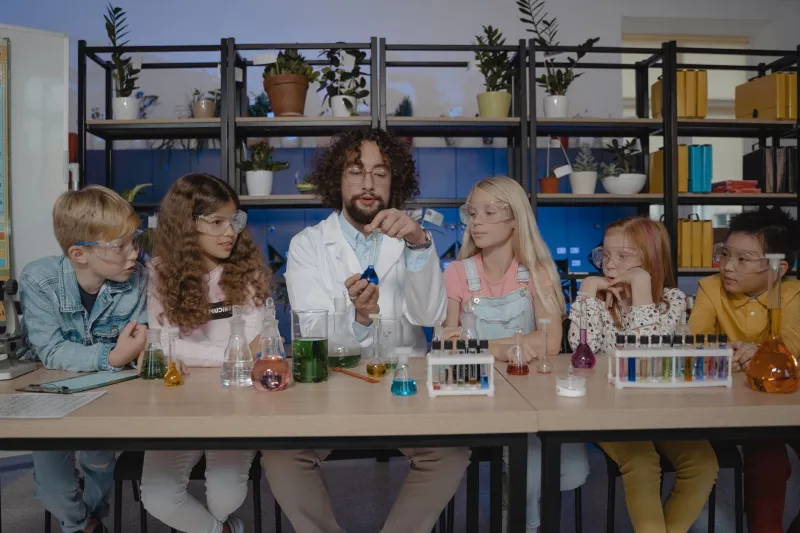
Let's be honest: America has a science problem. Not a lack of curiosity — walk into any elementary school and you'll find kids absolutely fascinated by dinosaurs, volcanoes, and why the sky is blue. The problem is somewhere between that spark of wonder and the 12th grade, something goes wrong.
Recent results from the Programme for International Student Assessment (PISA) placed American 15-year-olds 28th in math and 13th in science among the 37 OECD member nations. Countries like Singapore, Japan, South Korea, and even Estonia are consistently outpacing US students in the subjects that increasingly define economic opportunity in the 21st century. That's not a small gap — that's a chasm.
So what happened? And more importantly, what's actually being done about it?
Why the Gap Exists in the First Place
There's no single villain in this story. The reasons behind America's STEM performance gap are layered, systemic, and honestly — pretty frustrating to untangle.
For starters, inequity in school funding plays a massive role. Because much of public school funding is tied to local property taxes, students in lower-income zip codes often attend schools with outdated lab equipment, fewer advanced coursework options, and higher teacher turnover rates. Meanwhile, districts in wealthier suburbs are running robotics clubs, offering AP Chemistry, and sending kids to science fairs with professional-grade projects.
Then there's the issue of how science is taught. For decades, the dominant model has been lecture-heavy instruction: teacher talks, students take notes, everyone takes a test. Research has consistently shown this approach doesn't work well for building deep scientific understanding. Yet it persists, partly because it's easier to manage, partly because it's what standardized tests reward.
And let's not ignore cultural messaging. In many peer countries, academic achievement — especially in STEM — carries serious social prestige. In the US, that's a much more complicated picture. Students who excel in science sometimes face social friction, and the stereotype of who "belongs" in science (spoiler: it shouldn't be limited to anyone) still discourages countless young people, particularly girls and students of color, from pursuing these fields.
The Classrooms That Are Getting It Right
Here's where things get genuinely exciting. Because while the national averages are discouraging, there are schools and districts across the country doing something remarkable — and their results are turning heads.
High Tech High in San Diego, California has built an entire educational model around project-based learning (PBL). Students don't just read about ecosystems — they design and build functioning aquaponic systems. They don't just learn about structural engineering — they construct scale models and test them under real stress conditions. The school's graduation and college enrollment rates consistently beat state averages, and its model has been replicated in charter networks across the country.
In rural Appalachia, the Appalachian Regional Commission has partnered with local school districts to bring STEM programming to areas that are often overlooked in education reform conversations. Through mobile science labs and partnerships with regional universities, students in Kentucky and West Virginia are getting hands-on exposure to environmental science, coding, and biomedical research — fields directly connected to the economic future of their communities.
Chicago Public Schools launched a districtwide computer science initiative that now reaches over 100,000 students annually. By embedding coding and computational thinking into existing science and math classes — rather than treating it as an add-on elective — the program has made tech literacy feel accessible and relevant, not intimidating.
And in Houston, Texas, the Energy Institute High School has built its entire curriculum around the energy sector — not just fossil fuels, but renewables, grid systems, and environmental impact. Students intern with local energy companies, attend industry conferences, and graduate with credentials that make them competitive for both college and direct employment in one of the region's most important industries.
What These Success Stories Have in Common
Look closely at any of these programs and a few consistent themes emerge.
Relevance is everything. When students can see a clear connection between what they're learning and the world around them — their community, their potential career, a real problem they care about — engagement skyrockets. Abstract formulas become tools. Dry concepts become urgent.
Teachers need support, not just standards. The best STEM programs invest heavily in professional development. Teachers are given time to collaborate, experiment, and update their methods. They're treated as professionals, not just content deliverers. That distinction matters enormously.
Community partnerships amplify everything. Whether it's a local hospital, a tech startup, an environmental nonprofit, or a manufacturing plant — real-world partnerships give students mentors, context, and a sense of possibility that no textbook can replicate.
Equity has to be intentional. The programs that move the needle don't wait for motivated students to self-select into opportunities. They bring the opportunities to students who might never have raised their hand otherwise.
What You Can Do Right Now
If you're a student, a parent, or an educator reading this and wondering where to start — here are some concrete moves.
For students: Look beyond your classroom. Platforms like Khan Academy, NASA's student programs, and MIT OpenCourseWare offer free, high-quality science content at every level. Science Olympiad, First Robotics, and local science fairs are great ways to get hands-on experience and build a portfolio of real work.
For parents: Advocate loudly for project-based and inquiry-driven learning in your school district. Attend school board meetings. Ask your child's school what their STEM roadmap looks like — and push for specifics. Support doesn't have to mean expensive tutors; it can mean visiting science museums, watching documentaries together, or simply asking curious questions at the dinner table.
For educators: Connect with organizations like the National Science Teaching Association (NSTA) or your state's STEM network. Look for grant opportunities through the NSF's STEM education programs. And don't underestimate the power of simply letting students ask questions that don't have a pre-packaged answer.
The Bottom Line
America's STEM gap is a real problem — but it's not an unsolvable one. The evidence is already there, in classrooms from San Diego to rural Kentucky, that when students are engaged, supported, and given meaningful work to do, they rise to meet it. Every single time.
The question isn't whether American students are capable of competing on the global stage. They absolutely are. The question is whether the systems around them will give them the tools to do it.
At EduKasiceria Science, we believe that every learner — regardless of zip code, background, or grade point average — deserves access to great science education. And we're here to help make that happen, one discovery at a time.